
Rising waters | Rooted solutions
What Ousewem is learning about resilience at scale
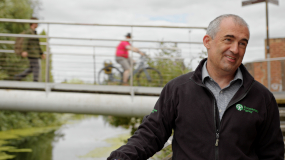
How can evidence, modelling and practical experience help inform future resilience decisions? Watch the latest Ousewem film.
Understanding how rivers and catchments function is only part of the challenge. The next question is how that learning helps inform future decisions.
Over the last few years, Ousewem has worked with partners, land managers and communities across the Swale, Ure, Nidd and Upper Ouse (SUNO) catchment to better understand how nature-based solutions can contribute to flood resilience and wider environmental outcomes. Through modelling, monitoring and practical delivery, the programme is building evidence about how catchments respond to change.
Watch the film
How can evidence, modelling and practical experience help inform future resilience decisions?
Scale matters
One of the clearest lessons emerging from Ousewem's work is that scale matters.
As our recent article explains, whole-system modelling allows us to explore what happens when interventions are considered across an entire catchment rather than at individual sites.
The results suggest that influencing flood risk and water quality at York requires action at significant scale and in appropriate locations throughout the upstream catchment. Meaningful change depends not only on individual measures, but on how multiple interventions work together across a connected river system.
Context matters
Scale is only part of the story.
Every catchment, river and landscape is different. Local evidence remains essential for understanding how interventions perform in specific places and under different conditions.
Whole-system modelling helps explain the bigger picture, while local modelling helps us understand what that might mean on the ground. At Hauxwell Estate, for example, local modelling has provided valuable insight into how different interventions interact with the landscape and why place-specific evidence remains so important.
Partnership matters
Flood resilience depends on decisions made across farming, environmental management, planning, infrastructure and local government.
No single organisation can deliver resilience alone.
One of the strongest lessons emerging from Ousewem is that evidence only becomes valuable when organisations, land managers and communities can work together to turn learning into action. Partnership working helps bring together local knowledge, technical expertise and practical delivery experience.
From evidence to decisions
Importantly, modelling is not intended to predict exactly what will happen in every location.
Instead, it helps build understanding of how different interventions may work together across a connected catchment and the scale of coordination, investment and long-term commitment that may be required.
As Ousewem moves towards the final phase of its current funding period, attention is increasingly turning towards how evidence and learning can support future planning, investment and delivery.
The challenge is no longer simply demonstrating that nature-based solutions can contribute to flood resilience and environmental improvement. It is understanding how evidence, partnerships and investment can work together to deliver those benefits at the scale required.
Local evidence helps us understand what works.
Whole-system modelling helps us understand what it takes to make a difference across an entire catchment.
Also see
