
Rising waters | Rooted solutions
What local modelling tells us about natural flood management
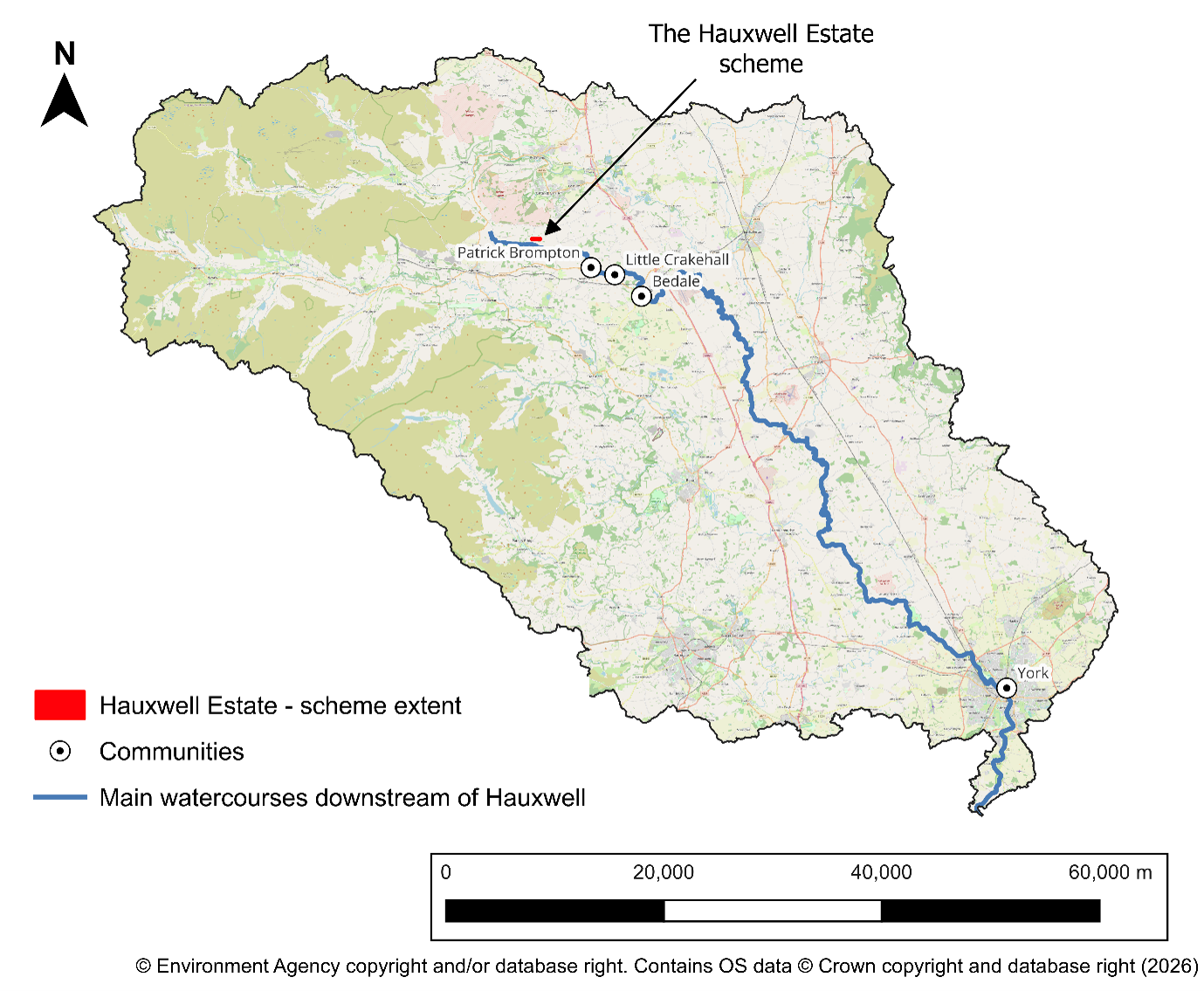
Hydraulic modelling at Hauxwell Estate shows how natural flood management can slow and store water locally, helping build confidence in the evidence needed for wider catchment-scale decisions.
Natural flood management (NFM) works by slowing, storing and filtering water within the landscape. But how much difference a scheme can make depends on the place, the design of the intervention, and the size of the rainfall event being considered.
That is why modelling at both catchment and site scale matters. Catchment-scale modelling helps Ousewem understand wider patterns across the Swale, Ure, Nidd and Upper Ouse catchments. Local hydraulic modelling helps show how individual schemes may perform in specific places. At Hauxwell Estate, recent modelling gives us a clearer picture of how NFM measures are expected to influence water movement across a range of flood events.
What the Hauxwell modelling shows
At Hauxwell Estate, recent modelling compared water movement before and after the natural flood management measures were delivered. These include bunds, scrapes, storage pools, new channels, enhanced floodplain connectivity and changes in vegetation within the wetland area, all designed to hold water back temporarily and release it more gradually.
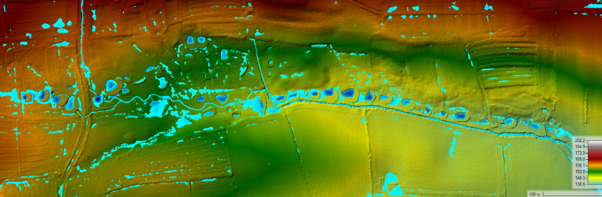
The modelling looked at three flood scenarios: a 10-year, 30-year and 100-year event. The clearest effect was seen in the smaller, more frequent event, where the model suggested peak flow could be reduced by around 25% immediately downstream of the scheme, with water moving downstream more slowly and around 3,000 cubic metres temporarily stored within the scheme.
Hydraulic model output showing areas where water is temporarily stored within the Hauxwell scheme during a rainfall event:
These results tell us how the intervention is performing locally. A separate question is how many local schemes would be needed to provide benefit further downstream to support other communities at risk, which is one of the questions explored through Ousewem's wider modelling programme.
For larger events, the effect was smaller at the monitoring location immediately downstream of the scheme. The model showed a reduction of around 6% of peak flow in the 30-year event and around 2% in the 100-year event.
This is an important finding. It does not mean the scheme is not working. It shows that storage-based NFM has physical limits. During larger storms, available storage fills more quickly, and once that storage is used, more water continues through the system.
What this tells us about NFM
The Hauxwell modelling demonstrates a realistic pattern of NFM performance. The scheme has the strongest effect during smaller and more frequent flood events, where storage has more capacity to slow and hold water. As events become larger, the influence of that storage reduces. This is consistent with how NFM is expected to work. It can reduce and delay flows in the right conditions, particularly where features are well designed and located.
However, However, this is only part of the picture. Just because the scheme at Hauxwell is providing a benefit immediately downstream, it does not tell us how far downstream that benefit is realised for, nor does it provide evidence for schemes being implemented elsewhere in the catchment.
Instead, the modelling reinforces one of Ousewem’s key messages: context matters. As we explored in our recent blog, [Where NFM works best – and why context matters], the value of NFM depends on local conditions, storage capacity, land use, floodplain connectivity and the scale of the event.
Read more about Where natural flood management works best.
Building confidence through evidence
For Ousewem, this kind of site-scale modelling is an important part of building the evidence base for natural flood management. It helps practitioners, land managers and partners understand not just whether NFM can work, but how it works, when it works best, and where its limits lie.
At Hauxwell Estate, the modelling shows that the NFM measures are functioning as intended, particularly for smaller, more frequent events where flood attenuation benefits are most significant. It also shows why modelling is most useful when it supports careful, place-based decision-making rather than simple claims of success.
Importantly, this kind of local evidence is about more than validating a single scheme. It helps build confidence in the methods, assumptions and approaches used to develop and implement NFM and understand its performance. Demonstrating that interventions are behaving as expected is an important step towards some of the bigger questions facing catchment-scale flood resilience: how benefits can be assessed consistently, how wider environmental and social outcomes can be recognised, and how future investment decisions can be informed by evidence rather than assumption. Before organisations commit to larger-scale delivery or investment, there needs to be confidence that the process and evidence underpinning those decisions is robust and repeatable.
As Ousewem continues to develop its evidence base, local modelling such as this will help inform future decisions about where NFM can make the most credible and proportionate contribution to flood resilience. It also provides an important foundation for understanding how local benefits translate into wider catchment outcomes. In a future blog, we will explore what Ousewem's whole-system modelling is beginning to tell us about the scale of action needed across the wider SUNO catchment.
Also see
