
Rising waters | Rooted solutions
Digging deeper: exploring soil health and flood resilience
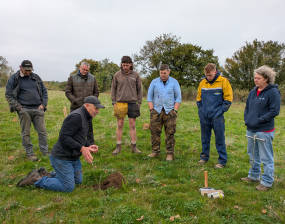
Ousewem is exploring how soil health management could become part of our offer to landowners. Soil health - how it’s maintained and improved - has been a missing piece we’ve wanted to test.
Healthy soils hold more water, support better crops and grass, and can quietly help reduce flood risk. This autumn, Ousewem teamed up with partners to look more closely at how soil health management fits into the wider picture of catchment resilience.
We’ve started with a practical event in Masham for farmers to share ideas and see soil management in action. Held with the Nidderdale National Landscape team at High Sutton Farm, farmers watched live demonstrations of an Aerworx aerator and a sumo trio subsoiler. Seeing both machines side by side sparked useful discussion about which might suit different types of land.
Jason Lock, who demonstrated the aeration equipment at the event, said:
“Good soil structure is at the heart of productive, resilient farming. Uncompacted, healthy soils can absorb more water, they support stronger crops and reduce runoff, benefiting both farmers and the wider catchment.”
Through this event, Ousewem is exploring how soil health management could become part of our offer to landowners. So far, most of our work has centred on things like hedges, tree planting, leaky barriers and scrapes and ponds. Soil health - how it’s maintained and improved - has been a missing piece we’ve wanted to test.
By working with catchment sensitive farming (CSF) teams, we’re looking at how to support soil health plans and, where it makes sense, to help fund soil tests or practical management such as aeration, sward lifting or subsoiling. Because soil health can take years to build, it’s important that these actions fit within a longer-term plan.
Compacted soil, caused by machinery or livestock, can stop water soaking in. That means water either sits on the surface, causing waterlogging, or runs off quickly, taking top soil and nutrients with it, and potentially contributing to flooding downstream.
Aeration and subsoiling can help restore structure, allowing water and air to move freely again. This encourages healthier crops and higher yields. Different machines suit different soils - subsoilers for arable land, aerators or sward lifters for pasture - but the goal is the same: healthy, well-draining soil that benefits both the farm and the catchment.
Rachel Flood, Ousewem project manager, said:
“By partnering with others and learning from what’s already happening, we can identify where Ousewem can add value and help build further resilience.”
Amanda Crossfield, NFM Programme Manager for Ousewem at the Yorkshire Dales Rivers Trust, added:
“Good soil health is the foundation of a profitable and resilient farm and we’re keen to work with farmers and our partners to build awareness and deliver practical solutions for farmers and landowners that benefit both them and their communities.”
This pilot event helps us:
- talk directly with farmers about what works for them
- understand where support is most needed
- strengthen partnership with Nidderdale National Landscape
Ousewem is about innovation through partnership - trying new things, learning what works and sharing that learning. By bringing science, farming practice and local knowledge together, we can better understand how soil and land management affect water across the catchment.
The intention is to share what we learned, including how farmers are putting soil health plans into action. In the meantime, we’d like to thank everyone involved - Nidderdale National Landscape and Catchment Sensitive Farming, Aerworx, Sumo and of course our host, Steve - for helping us dig a little deeper into the role of soils in flood resilience.
Also see
